
Autoclave & Ultrasonic Equipment
The sterilization room is three jobs on one bench: cleaning an instrument before anything is packed, sealing the pack, and proving afterwards that the cycle it went through actually worked. This page covers the units that do those three jobs - the ultrasonic tank, the constant-heat sealer, the incubator and the indicator reader - plus the consumables each one depends on. Packaging sits under sterilization pouches and the tests sit under autoclave monitoring and spore testing. The sterilizer itself is not sold here: the Class B benchtop unit on our site is a pre-launch listing, not a purchasable model, so nothing on this page assumes you are buying an autoclave from us.



-
Sterilization & Infection Control > Steril...$860.00CAD
-
Sterilization & Infection Control > Steril...$609.00CAD
-
Sterilization & Infection Control > Steril...$466.00CAD
-
Sterilization & Infection Control > Steril...$717.00CAD
-
Sterilization & Infection Control > Steril...$2,869.00CAD
-
Sterilization & Infection Control > Steril...$1,076.00CAD




More about Autoclave & Ultrasonic Equipment
Short answer: a single-surgery dental clinic, veterinary practice or med-spa running one autoclave needs a 6 L ultrasonic tank that takes a full instrument cassette, a 12 mm constant-heat pouch sealer, and a dry-block incubator for 24-hour spore tests. Add a 4-well fluorescence reader only if the daily test is a 20-minute, 1-hour or 3-hour rapid-readout indicator. Cycle volume decides the size, not the catalogue.
How many cycles a week does the room actually run?
Count it before ordering anything, because the count sets the tank, the block and the number of spare wells. The arithmetic that survives an inspection is simple: cycles per day, multiplied by days the autoclave runs, gives the number of packs that have to be sealed and the number of indicator wells that get filled.
Take a four-chair dental clinic that runs the autoclave four times a day, five days a week. That is twenty cycles and twenty packs to seal, and at one biological indicator per sterilizer per monitoring day it is twenty wells filled in a week. Run six days and the figure climbs to twenty-four. A 20-well dry block - the HB105-S1 dry-bath incubator - is then full with no room left for the re-test after a failed indicator, which is the seat you only need on the week you need it badly. Two sterilizers, or a second suite in the same building, is where a block with spare capacity stops being optional.
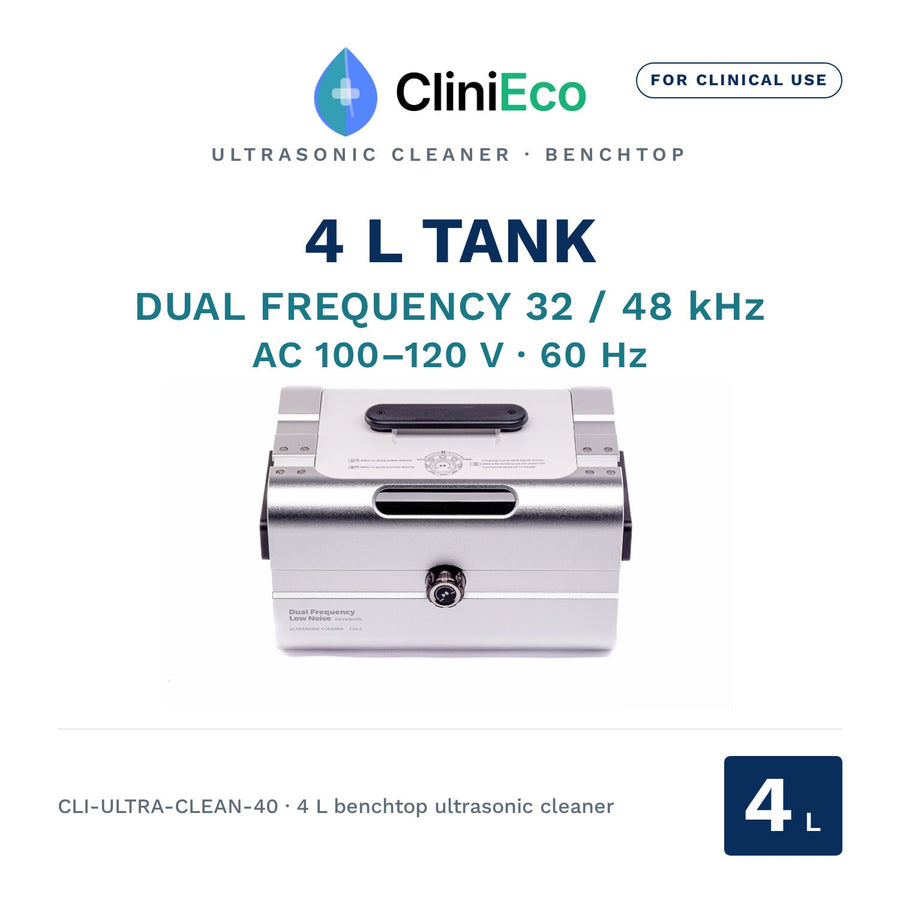
The cleaning side counts differently. A 6 L ultrasonic tank holds one full instrument cassette per cycle, because the tank floor is 31.1 by 17.2 cm - the footprint a standard cassette needs. If your instruments arrive loose instead of in a cassette, you are either unpacking them onto the basket or running two cycles, and that is the point at which a second tank or a longer working day becomes the cheaper decision. The CS6.2 6 L dual-frequency cleaner is sized around that single-cassette cycle: 32 kHz for heavier soil, 48 kHz to reach lumens and threaded joints, with a 120-second degas at the start of the run so the first load is not fighting a head of air.
Which configuration fits a one-chair practice, a four-chair clinic, or a building with two sterilizers?
The table below is the same decision, stated three ways. Read across the row that matches your cycle count rather than the row that matches your ambition - the units are not upgradable after the fact, and buying a size up usually means a tank that sits half loaded.
| Room profile | Cycles per day | Cleaning | Sealing | Incubation and readout | Why this row |
|---|---|---|---|---|---|
| Single surgery (solo dental, vet, med-spa, tattoo studio) | 1-4 | 6 L tank, multi-enzyme concentrate at 1:400 | 12 mm constant-heat sealer, or self-sealing pouches if every pack fits a stocked size | 20-well dry block plus 24-hour spore tests | One cassette per cycle; one indicator well per operating day leaves seats to spare |
| Multi-chair clinic (4-8 chairs, one autoclave) | 6-10 | Same 6 L tank run back to back; solution bought by the larger pack | Sealer in continuous operation after a 2-3 minute pre-heat | 24-hour block with USB data export, or a second 20-well block | Wells run out before the tank does; export replaces a hand-copied temperature |
| Building with two sterilizers, or a suite per floor | 10+ | One tank per reprocessing room, not one tank shared between floors | Second sealer only if both rooms pack separately | 4-well fluorescence reader if the daily test is rapid-readout | BIs are counted per unit per day, so the block and the reader both double |
What are the specifications, compatibility limits and shipping format of each unit?
Every figure below is the one an order turns on: the seal width that decides whether a pack peels cleanly, the well diameter that decides whether an ampoule seats flush, and whether the unit leaves as a single bench machine or a case pack. Consumables are separate lines throughout - the tank does not ship with solution, the reader does not ship with ampoules.
| Unit | Key specification | Compatibility that decides the order | How it ships |
|---|---|---|---|
| CS6.2 ultrasonic cleaner | 6 L tank, 31.1 x 17.2 x 11.6 cm; dual frequency 32/48 kHz; two ceramic heaters; digital timer; 120-second degas | One full instrument cassette per cycle; certification by Intertek to CSA C22.2 No. 68 and UL 73 (cETL) | Single bench unit with basket, part SB01; replacement baskets ordered separately |
| Multi-enzyme cleaning solution | Protease, lipase, amylase and cellulase; low-foam; 1:400 to 1:600; 2-10 minutes at 20-50 degrees C | A 6 L tank takes 15 mL at 1:400 (10 mL at 1:600); 24 months sealed, 90 days after opening | 1 L bottle or 5 L pail; one 5 L pail makes 2,000 to 3,000 litres of working solution |
| Constant-heat pouch sealer | 200 degrees C thermostatic head; 12 mm seal width; 300 mm maximum seal length; 100 W, 110 V / 60 Hz; IPX0 indoor use | Pouches and rolls up to 300 mm wide, three rolls side by side; 2-3 minute pre-heat then continuous operation | One stainless-steel bench unit with built-in cutter; no consumables included |
| HB105-S1 dry-bath incubator | 20 wells (5 x 4) at 11 mm; room temperature +5 to 105 degrees C; +/-0.5 degrees C control; 115 V, 110 W | Self-contained vials of 8 mm body and 10 mm cap; cTUVus to UL 61010-1 and CAN/CSA-C22.2 No. 61010-1-12 | Single unit, 3.2 kg with block fitted; display only, no data export |
| 24-hour incubator with USB export | 56-60 degrees C held to +/-0.5 degrees C; 8.8 mm machined wells; LCD with USB data export; 100-240 V adapter | Ampoules read at 56-60 degrees C, the growth band for Geobacillus stearothermophilus | One bench unit; no case pack exists, and a two-year warranty applies |
| 4-well fluorescence reader | Four wells, model TR-R30MP4, held at 56-60 degrees C; reports positive or negative fluorescence; USB result storage | Reads 20-minute, 1-hour and 3-hour fluorescence ampoules; none are included in the box | Instrument only; ampoules reordered as separate 50-packs |
Do you need a pouch sealer if you already buy self-sealing pouches?
Self-sealing pouches close on a pressure-sensitive strip: no machine, no pre-heat, one fixed size per pack, and nothing to warm up at the start of the day. A sealer covers the two cases a pre-made pouch cannot. Packs longer or wider than any stocked size, and rolls cut to the length the pack actually needs - the 76 mm by 50 m sterilization roll is the usual starting point, and a 30 cm cut gives roughly 166 pouches per roll. If every pack you make already fits the Class 4 self-sealing pouch you buy, the sealer adds a step and removes none.
The seam is the part that matters. A constant-heat head holds one temperature for the whole run instead of spiking per impulse, and the 12 mm band is the full width of the heating element, which is what lets the pack peel open at the point of use without the film tearing away from the paper. That is a packaging decision, not a sterilization one: the seal keeps the contents sterile until opening, and the indicator inside the pack is what reports whether the cycle reached it.
What has to be in place before the units go into service?
Three things, and none of them is optional. First, the electrical side: the cleaner is certified to CSA C22.2 No. 68 and UL 73, the dry block to CAN/CSA-C22.2 No. 61010-1-12, and all of it runs on 110-115 V at 60 Hz in a Canadian clinic. Second, the water and the bench: the tank needs a low-foam enzyme at the dilution above, a rinse step after the cycle, and an indoor IPX0 position that will not be splashed. Third, the monitoring routine, which has to start with the first cycle rather than the first inspection.
In Ontario, the dental regulator's infection-control standard expects a biological indicator on every day a sterilizer runs, a chemical indicator in every pack, and a written record of both. The practical version of that routine is a 24-hour self-contained spore test read by colour change, a Class 5 integrator (ISO 11140-1 Type 5) in each pack, Bowie-Dick packs (ISO 11140-5 Type 2) for the daily vacuum check on a pre-vacuum unit, and Class 1 indicator tape on the outside. Practices that read rapid results instead use the 20-minute or 3-hour fluorescence ampoules in the reader above.
What none of that does is certify a load as sterile. An indicator reports the conditions inside the pack it travelled in; it is evidence about the cycle, not a statement about every instrument in the room. The record is what turns the evidence into something an inspector can check, and the field list for it is at the compliance log centre, printable and free to use.
Batch, compatibility and ordering notes
- Consumables never ship with instruments: no ampoules with the reader, no solution with the tank. Order both lines or nothing runs on day one.
- Well diameter is a specification, not a detail. An 11 mm block takes an 8 mm vial body with a 10 mm cap; a wider cap will not seat, and a loose tube with an air gap around it is the usual reason one indicator in a batch reads late.
- The incubator and the reader leave as single bench units. There is no case pack of either, and no quantity discount that changes the fact that one reprocessing bench needs one of each.
- Solution has a clock: 24 months sealed, 90 days once opened, so a larger pack only saves money if the volume justifies it inside that window.
- Equipment ships under CliniEco Medical's MDEL #35334 as a licensed importer and distributor; documentation, manuals and certificates are supplied as documents on request.
- French-language manuals are available on request; the units themselves are marked in English and use North American plugs.
Three bench units answer the same question at three different speeds, and the well count is the number that decides which one a room needs: a 20-well laboratory dry bath, a 24-well precision block, and a 4-well reader that returns a result inside a shift. Read them against the same week of cycles before choosing between them.
How many wells do the three incubation units actually hold?
Count one well per sterilizer for each day it is run: the daily spore test belongs to the load, not to the machine per month. A single autoclave on a five-day week fills 5 wells, a six-day week fills 6, and a building with two sterilizers fills 10 to 12. That leaves the 20-well Biological Indicator Incubator — DLAB HB105-S1 Dry Bath, 20-Well with room to spare, and the 24-well precision block with a little more, which is the seat that matters on the Friday a failed indicator has to be re-tested before Monday. The 4-well reader is not a smaller version of either: its four seats are a read capacity for one batch of rapid ampoules, and one seat is spoken for whenever an unexposed control is incubated alongside a new lot. Four wells suit one sterilizer running one rapid test a day; two sterilizers running two cycles a day fill the reader before the day starts.
| Property | HB105-S1 dry bath | Precision dry block | Rapid reader |
|---|---|---|---|
| Wells | 20 (5 × 4) | 24, machined aluminium | 4 |
| Well diameter | 11 mm | 8.8 mm | Accepts 8–11 mm ampoules |
| Temperature held | Room temperature +5 to 105 °C | 56–60 °C, ±0.5 °C | 56–60 °C |
| Readout window | 24 hours, read by colour | 24 hours, read by colour | 20 minutes, 1 hour or 3 hours |
| Records | Display only, no export | LCD with USB data export | Positive or negative result, USB storage |
| Seats left for a re-test | 14 on a six-day single-unit week | 18 on a six-day single-unit week | No spare seat once a batch of four is loaded |
How long until a result: 24 hours, or the length of one shift?
The readout time is set by the vial, not by the block. A 24-hour self-contained indicator is held at 56–60 °C for the full period and then read by eye — purple passes, yellow fails — which means today’s last load is answered tomorrow morning and no reader is involved. The CliniEco 24-Hour Biological Indicator Incubator — Precision Dry-Block is the unit that holds that vial and exports the temperature trace for the file. A fluorescence ampoule is read in the instrument after 20 minutes, 1 hour or 3 hours, and the CliniEco Rapid Reader — 4-Well Fluorescence Biological Indicator Reader is what reads it; that reader cannot read the 24-hour vial, because the vial needs no instrument at all. The purchase therefore splits two ways: an incubator plus a vial per day, or a reader plus the rapid ampoule per test, where the hardware is bought once and the ampoule is bought every month. The per-test figure follows from dividing the ampoule pack price by the count inside it, so both lines can be compared on the same basis before either order is placed.
Where to go next
Clinics ordering a full room - tank, sealer, block, reader and the consumables behind them - can open an account with volume terms on the clinic and institutional ordering page. If the question is not which unit but which monitoring interval applies to your sterilizers, that answer belongs with a specialist: send it through the sterilization compliance consultation and it comes back in writing, with the standard behind it. Packaging and the tests themselves are one click away in the two collections linked above.