
Specimen Collection & Waste
Specimen containers, sample cups, 95 kPa transport bags, sharps containers and biohazard waste bags.
A specimen leaves a clinic in one of three ways: in a transport bag, in a sharps container, or in a red bag. The packaging around it decides whether the sample reaches the laboratory intact and whether the waste leaves the building lawfully, so the bags and containers on this page are bought as a chain. Every specification below is taken from the product pages themselves, so each can be checked against the listing before an order is placed.


-
Sterilization & Infection Control > Medica...$65.00CAD
-
Examination & Diagnostics > Laboratory Con...$29.00CAD



More about Specimen Collection & Waste
Which waste stream does each container belong to?
Three streams, three containers. Sharp items go into a rigid 1-quart sharps container at the point of use and never into a bag. Soft biomedical waste goes into a red 30-gallon biohazard bag that lines the bin, is closed at the neck when the bin is changed and moves to storage without being decanted. General waste carries no biohazard marking and travels separately.
The two streams stay apart: a red bag containing a needle cannot be handled by the person collecting it, and a sharps container has to be rigid enough that the contents cannot reach the hand that closes it.
What has to be on a red bag before it goes into service?
Three things, all visible on the bag itself: the red film, the biohazard symbol, and a marking that reads in both English and French. Those are the three the listing states, and they are the checks that can be made at goods-in without unrolling the pack. Which stream the bag is used for, and how full it may be filled, is set by the rules of the province the facility operates in.
Sealed leak-proof seams alone are not enough: the page states the pair to look for together, sealed seams plus enhanced puncture and tear resistance in the polyethylene film.
Do you need a 95 kPa specimen bag or a three-wall bag?
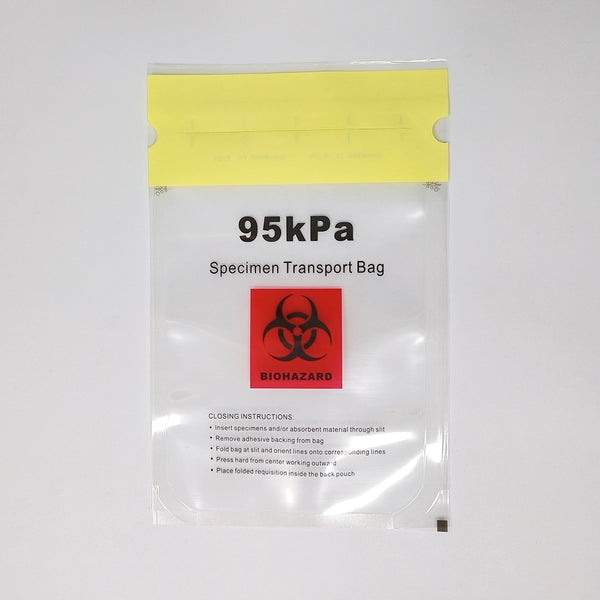
The split is by how the specimen travels. A UN3373 95 kPa specimen transport bag covers Category B biological substances, with P650 applying on the road and IATA 650 in the air. The three-wall 6 by 9 inch bag is built for specimens that move by ground, and its page states plainly that it is not pressure-tested for air transport.
That one sentence is the whole decision, because a flight brings the 95 kPa test into scope. No design-type approval is issued for the 95 kPa bag, and packing duty rests with the shipper.
How many specimens does one bag or one case carry?
Counts are per bag, not per case, because nobody opens a case at a time. One specimen goes into one bag: the sample into the main compartment, the requisition into the document pouch where it can be read and stamped without opening the biohazard bag. The 95 kPa bags carry two pockets for that reason — front pocket for the container and absorbent material where P650 (7)(d) requires it, back pocket for the requisition — and the 95 kPa figure is the internal pressure test in P650 (7)(e), held without leakage.
| Item | Size or capacity | Pack and case count | Stream |
|---|---|---|---|
| UN3373 95 kPa transport bag | 6 by 9 in up to 12 by 15 in, two pockets plus document pouch | 100 per box, 1,000 per case | Air and road Category B |
| Three-wall transport bag | 6 by 9 in, absorbent pad about 3 by 5 in, press-to-close seal | 1,000 bags (10 boxes) | Ground transport only |
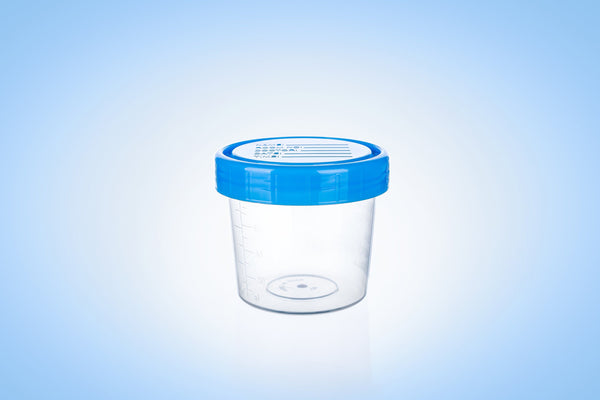
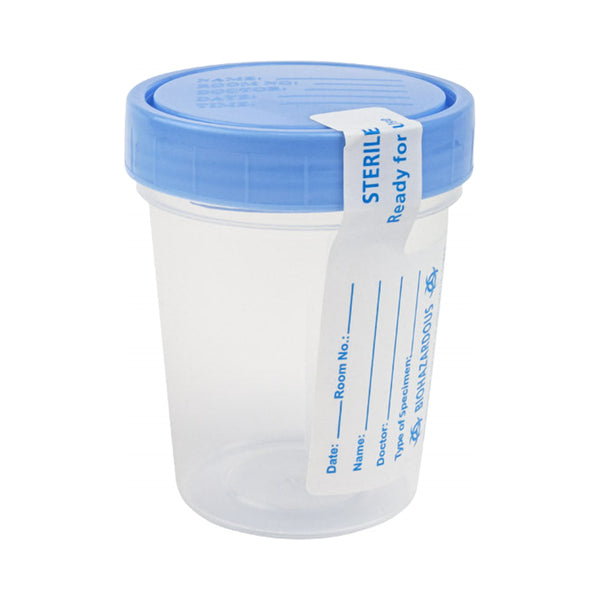
| Screw-cap specimen container | 120 mL, moulded side-wall graduations | 100 per pack, 200 per 2-pack | Primary container |
| Graduated specimen cup | 90 mL, graduations in millilitres and ounces | 100 per bag, 600 per case | Primary container, routine urine |
| 1-quart sharps container | 1 quart (about 0.95 L), locking lid, restricted opening | 20 per case | Sharps |
| Red 30-gallon biohazard bag | 30 gallon, red film, bilingual marking | 5 per pack | Soft biomedical waste |
Which container fits the sample — a 90 mL cup or a 120 mL container?
The 90 mL cup is the routine urine container, graduated in millilitres and ounces so a collection site reads a volume without a cylinder. Its sterility line reads "non-clean (clean option available)", which should be read literally before an order goes in for microbiology, because a clean container and a sterile container are not the same thing. The 120 mL screw-cap container is sterile and single use, with a threaded leak-resistant cap, and it is the larger option at a site collecting a bigger volume.
What travels around the container changes with the shipment: Category B shipments move as triple packaging, with a leak-proof primary, absorbent material and a secondary package rated to hold a 95 kPa pressure differential.
How do you label samples and store waste before pickup?
The three-wall bag carries a write-on zone for the collection details and a barcode area for the laboratory's tracking label, both on the outside, so the requisition never has to be removed to identify the sample. The outer document pouch exists for the same reason: a form outside the biohazard bag can be read, stamped and checked at the pickup point without opening it.
A filled sharps container is closed when the sharps reach the visible fill line, not at the brim: a container filled above the line cannot be closed safely, and the restricted opening stops working once the contents stand above it. Keep the replacement within arm's reach so the closed container is never set down on a bench.
Where do you order specimen transport bags and waste containers in Canada?
The full chain — containers, bags, sharps containers and red bags — sits in the case and volume supply collection, and the transport decision above is covered in more depth in our UN3373 packaging guide. A site that knows how many specimens it collects per pickup day can put that count into the supply planner and read back the months of cover one case gives it.
Order from the case and volume supply collection, size a first order with the clinic supply and cost planner, or read the transport rules in UN3373 specimen bags and IATA 650 packaging and closing and lifting a full red bag.