
Adult Diapers & Briefs
This range covers four absorbency tiers of taped and pull-on adult briefs, three underpad formats and a pre-assembled urology kit for home care, long-term care and clinic use. The choice rests on how much one change has to hold, by whether the wearer can manage their own toileting, and by the case count a floor gets through in a week.
- Bulk Case (120 Pack)$215.00
$253.00CAD


-
Bulk Case (120 Pack)$146.00
$172.00CAD -
Bulk Case (120 Pack)$172.00
$202.00CAD


More about Adult Diapers & Briefs
How is the absorbency tier chosen — 3,000, 4,000 or 5,000 ml?
The millilitre figure is the capacity of the absorbent core as the manufacturer states it: a super absorbent polymer layer combined with fluff pulp, rated for a stated volume. It is a comparison figure, not a promise that the wearer will stay dry for a fixed number of hours, because urine output, body position and how often the brief is checked all move the real interval. The working rule in most care settings is to match the tier to the longest unbroken stretch the person is left in one brief: a day brief for the daytime round, a higher-capacity brief for the overnight stretch.
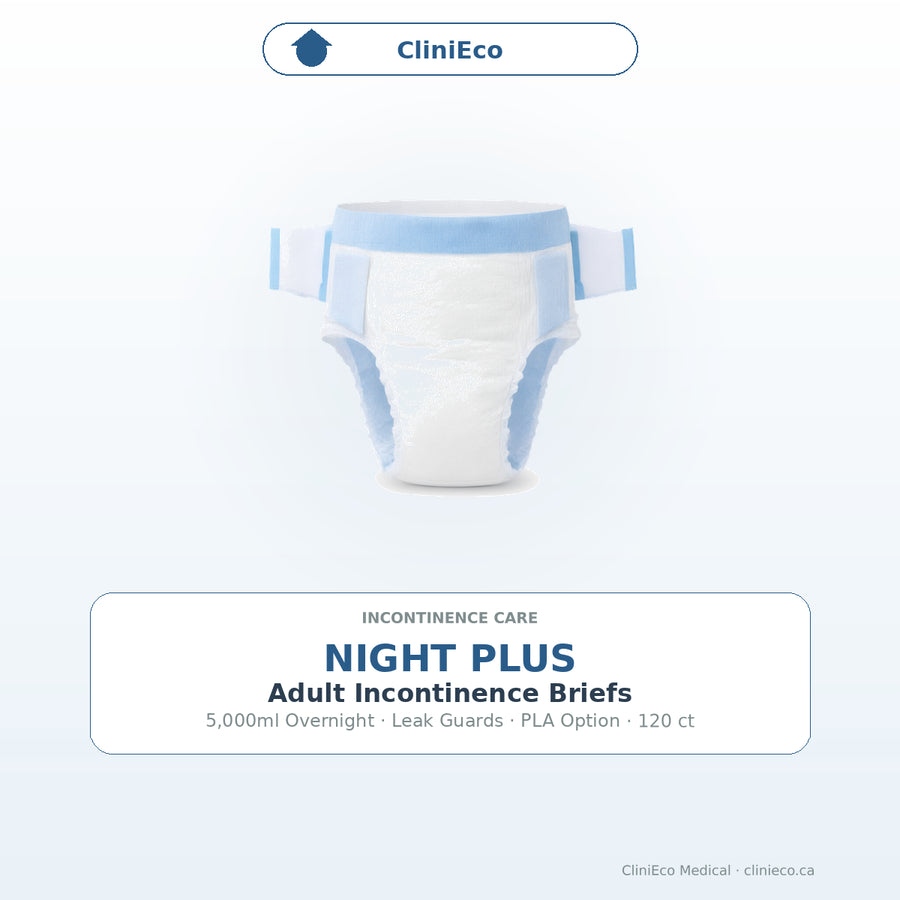
Read across the three tiers as a ladder. The Day Comfort adult briefs at 3,000 ml suit light to moderate daytime use and are the tier a home-care family usually starts with. The Day Pro adult briefs at 4,000 ml add capacity and a wetness indicator for moderate to heavy daytime use, and the indicator is what lets an assisted change be decided by inspection rather than by the clock. The Night Plus overnight briefs at 5,000 ml carry the largest capacity in the range and are ordered for the night round, not for the whole day.
Pull-on or taped brief — which suits which resident?
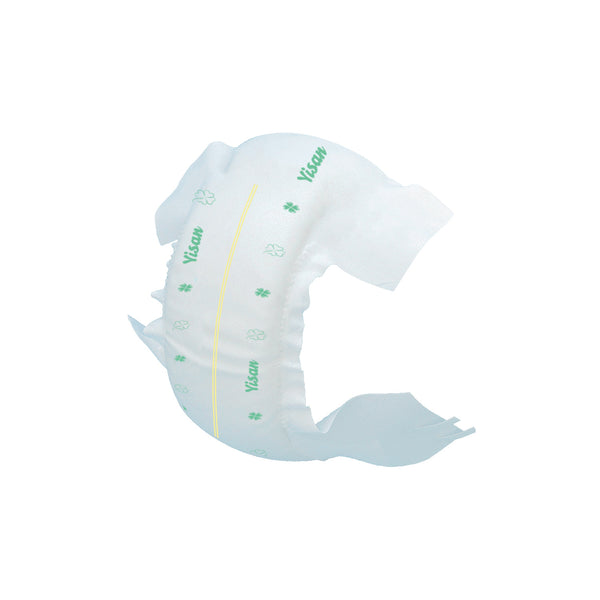
The dividing line is who does the changing. A taped brief is opened flat, positioned and refastened, so it can be applied and checked with the person lying down — the format for a bed-bound resident and for a two-person change. A pull-on brief is stepped into and pulled up like underwear, which suits an ambulant resident who toilets independently and wants to manage the change alone; it is the wrong format for someone who cannot stand, because it has to be removed and replaced rather than opened.
That is the whole reason the range carries both: the adult pull-on briefs at maximum absorbency are bought for the residents who walk to the washroom, and the taped tiers above are bought for the residents who do not. Mixing the two on one floor is normal; the split should be written on the supply list by resident, not by bed count.
How many briefs does a 40-bed floor use in a week?
Start from the changes-per-day figure your own procedure sets and do the arithmetic once. At two briefs per resident per night, a 40-bed floor draws about 80 briefs a night — roughly 560 a week. Every brief in this collection is sold as a case of 120, packed as six packs of 20, so a case covers about 20 resident-days at six changes a day and the night round alone works out at four to five cases a week. Add the daytime round to that and the weekly draw is the number the stock room should hold to, not the number of briefs visible on the shelf.
The case count also decides the unit being reordered. There is no single-pack option on the taped tiers, so a floor that runs short mid-week is short until the next case arrives; the order point is a week of supply, not a day.
Which underpad goes under which brief?
An underpad is not a second brief. It protects the mattress, chair or exam surface from the leak that gets past the brief, and it is changed at the same time as the brief. Size it to the surface area at risk rather than to the brief: a 30 × 36 inch pad covers a chair, a wheelchair seat or a single bed position, while a 60 × 90 cm pad covers the width of a care bed and is the format a floor uses at night.
The disposable underpads at 30 × 36 in with heavy absorbency are listed in a four-pack, which is a trial quantity and a single-bedroom quantity rather than a floor quantity — useful for a home-care family confirming fit before moving to a case. The 60 × 90 cm five-layer underpads with SAP come as ten boxes of fifty, 500 pads to the case, and the box of fifty is the unit a store room hands out. For a facility under a waste-reduction target, the PLA biodegradable underpads, 30 × 36 in replace the polyethylene backing with a plant-based PLA film and are sold fifty to a case; the manufacturer's composting conditions are stated on the product page and are worth reading before the pad is filed as compostable in your waste stream.
When does the urology care kit beat buying the items separately?
A kit is a picking decision made once instead of four times. The urology care kit gathers the items a perineal care round needs into one package, which helps where the ordering is done by someone who does not stock the cupboard — a home-care agency setting up a new client, a ward opening a bed, a discharge planner building a take-home pack. Where a facility already holds each component on its own line, buying separately keeps the reorder cycles independent; the kit is for the setting where a single item number is worth more than four.
What should be recorded in the purchasing file before the first order?
Five fields, because each one is what a later substitution goes wrong on: the brief format (taped or pull-on), the absorbency tier in millilitres, the waist or hip size range the resident is measured at, the case pack count, and the change frequency the care plan sets. Absorbency tier and format are the two that cannot be swapped without changing the care routine, and a size range taken from a waist measurement rather than from the previous brand's label is the one that survives a brand change.
Absorbency, format and case pack at a glance
| Item | Format | Absorbency as stated | Case or pack | Typical setting |
|---|---|---|---|---|
| Day Comfort adult briefs | Taped brief | 3,000 ml | 120 per case, 6 packs of 20 | Home care, light to moderate daytime use |
| Day Pro adult briefs | Taped brief, wetness indicator | 4,000 ml | 120 per case, 6 packs of 20 | Long-term care daytime round |
| Night Plus briefs | Taped brief | 5,000 ml | 120 per case, 6 packs of 20 | Overnight round, 10 to 12 hour stretch |
| Pull-on briefs | Pull-on underwear | Maximum tier | 120 per case, 6 packs of 20 | Ambulant residents who self-toilet |
| Underpads, 30 × 36 in | Flat pad, heavy absorbency | Heavy | 4-pack | Trial quantity, chair or single bed |
| Underpads, 60 × 90 cm | Five-layer pad with SAP | Heavy | 500 per case, 10 boxes of 50 | Care-bed width, night round |
| PLA biodegradable underpads | Flat pad, PLA backing | Heavy | 50 per case | Facilities with a waste-reduction target |
| Urology care kit | Assembled kit | Heavy pads and accessories | One kit | Ward setup, discharge pack, new home-care client |
Where are price, stock and case pack read from?
Each item links to its own product page, and that page is the only place the current variant, price, stock state and case pack should be read from — not from this page and not from a previous order form. Case pack counts and variant names change between lines (a case of 120 is not the same picking unit as a box of 50), so the page also states which unit is actually sold. Facilities ordering for more than one floor or more than one site can set a standing monthly order through the account enquiry page, where sizing, absorbency and case counts are confirmed before the first shipment rather than after it.
Incontinence products are sold as described by their manufacturers, with absorbency figures taken from the manufacturer's stated specification. Nothing on this page is medical advice; the choice of product, change frequency and skin care routine belongs to the clinician or care team assessing the individual.
CliniEco Medical distributes these products in Canada under MDEL #35334, shipping from its Toronto warehouse.